Decoding Crash Games: Provably Fair Math Powering Aviator and Bustabit Multipliers
Written by Eden Jung · Apr 15, 2026
Decoding Crash Games: Provably Fair Math Powering Aviator and Bustabit Multipliers
The Surge in Crash Game Popularity
Crash games have exploded onto online gaming platforms since their debut around 2016, drawing millions of players worldwide with their simple yet nerve-wracking mechanics where a multiplier starts at 1x and climbs unpredictably until it crashes, forcing bettors to cash out before the bust or lose everything. Aviator from Spribe and Bustabit stand out as pioneers, powering sessions on sites from Stake to BC.Game, and as of April 2026, industry trackers report over 5 million daily active users across these titles alone, a figure that underscores their grip on the crypto casino scene while regulatory bodies like Ontario's Alcohol and Gaming Commission monitor their growth closely.
What's driving this? Players chase those heart-pounding multipliers that can hit 100x or higher in rare spikes, but the real hook lies beneath the surface in provably fair systems that let anyone verify outcomes weren't rigged, turning what could be blind trust into transparent math everyone can check. Observers note how this tech, rooted in cryptography, emerged from Bitcoin dice games and evolved into crash's core engine, ensuring servers can't manipulate crashes post-bet.
Unpacking Provably Fair Technology
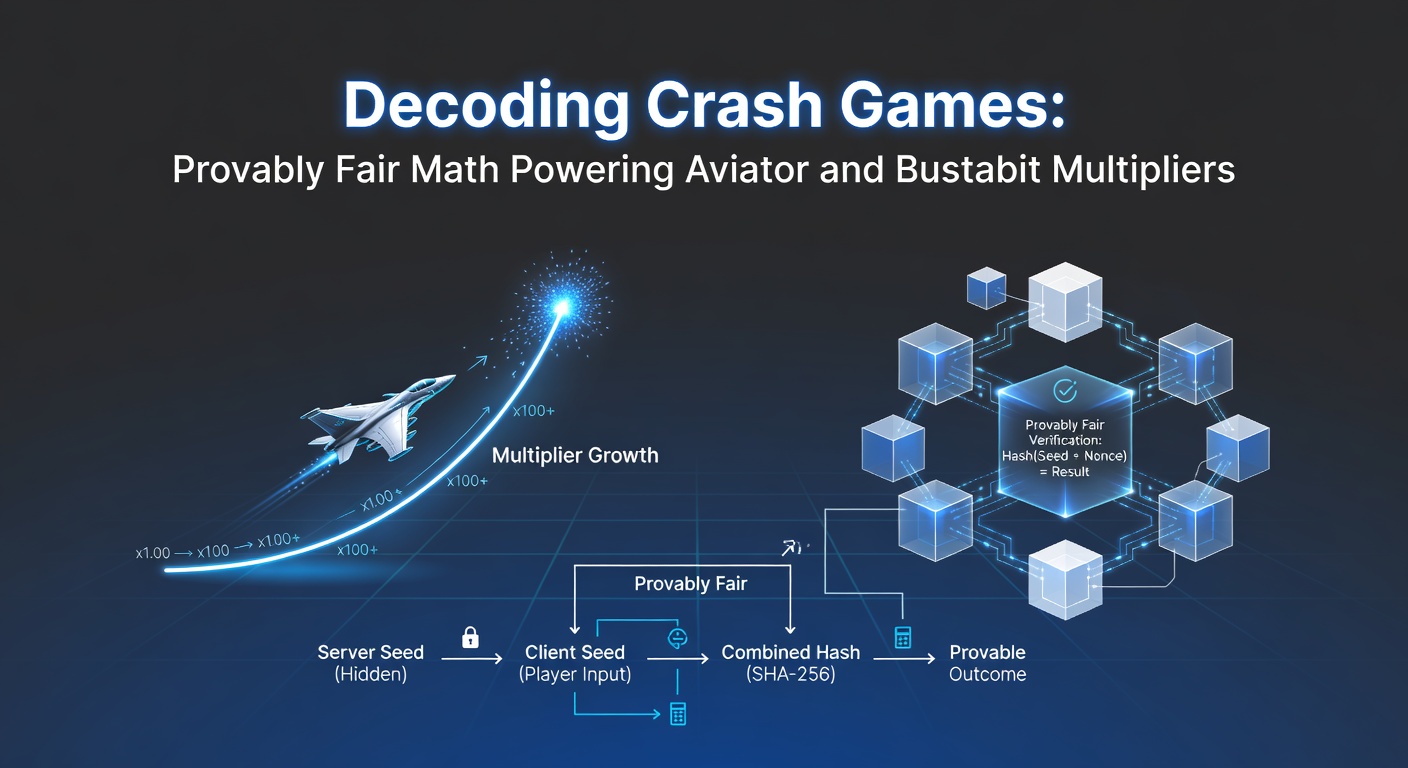
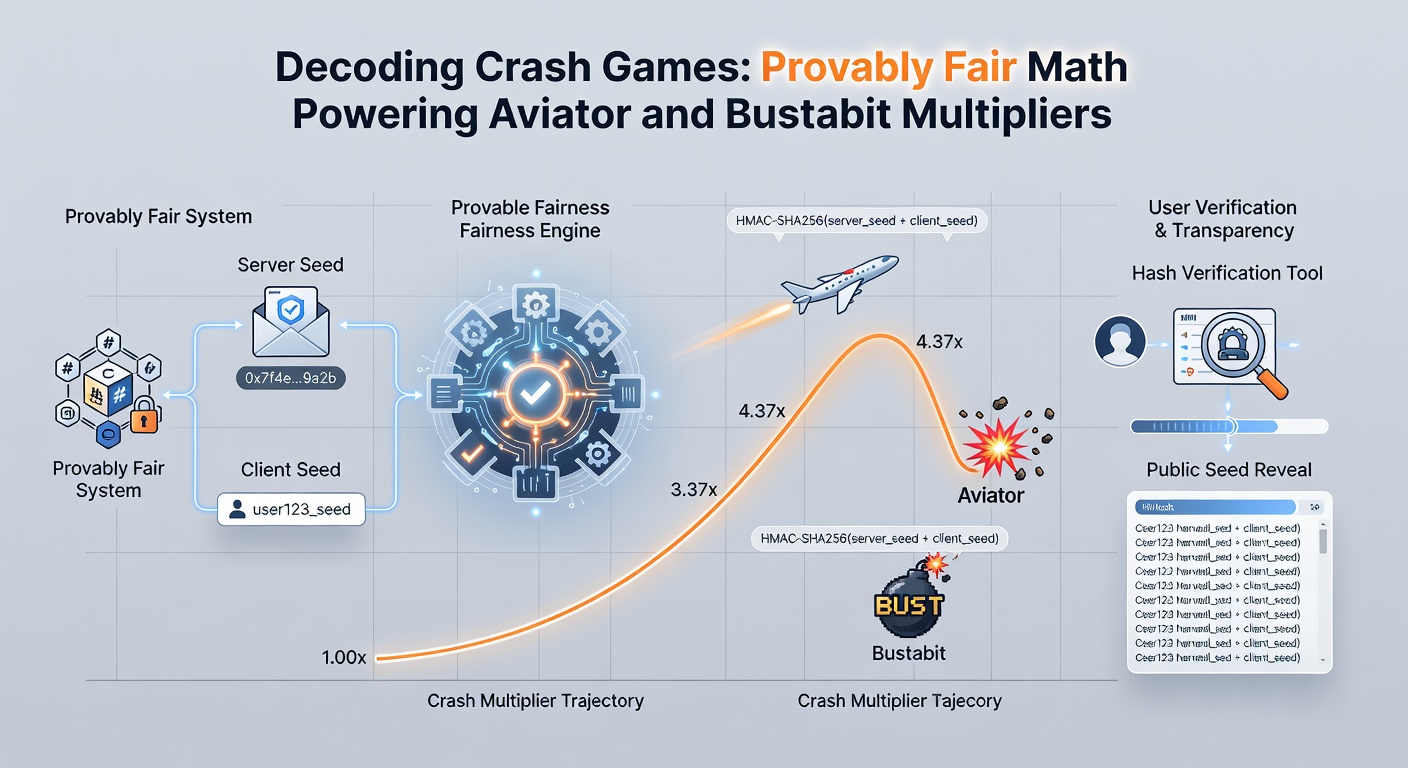
Provably fair hinges on public-private seed mechanics combined with cryptographic hashing, where platforms generate a server seed kept secret until the round ends, pair it with player-chosen client seeds and a nonce like the round number, then compute a hash via HMAC-SHA256 or SHA512 to derive the crash point deterministically. Players verify by checking the revealed server seed against a pre-published hash commitment, confirming no tampering occurred, a process that gaming watchdogs such as Malta's Gaming Authority highlight in their fairness guidelines for licensed operators.
Take a typical round: the server commits to a hashed server seed before bets close; players submit client seeds (often randomized per session); the nonce ticks up per game; everything feeds into the hash function, spitting out a unique string that algorithms convert into a multiplier, all without the house peeking or altering mid-flight. This setup, battle-tested over billions of rounds, eliminates the "house always wins" skepticism that plagues traditional slots, and developers open-source their code on platforms like GitHub for extra scrutiny.
But here's the thing; while the tech sounds airtight, execution matters, so top sites publish seeds in real-time JSON APIs, letting tools like bustabit-verifier or Aviator checkers crunch the numbers instantly. Experts who've dissected thousands of rounds confirm crash distributions match house edges of 1-5%, with low multipliers far more common than jackpot crashes, a statistical reality baked into the formulas.
Aviator's Multiplier Math Revealed
Spribe's Aviator, launched in 2019, powers multipliers through a SHA512-based system that generates crash points from a blend of one server seed and two client seeds plus nonce, producing a 128-character hash from which the first 16 hex characters convert to a decimal number between 0 and 1e16. Developers then apply the formula: multiplier = Math.max(1, (2^32 * 100) / (2^32 - (parseInt(hash.substr(0,8),16) % 2^32))), clamped to prevent infinities, ensuring a 1% house edge where crashes below 2x occur about 49% of the time according to simulations run by independent auditors.
And it gets nuanced; if the hash-derived value exceeds certain thresholds, the game floors at 1x or caps wildly high, but data from millions of Aviator rounds on platforms like Pin-Up shows average crashes hover around 1.5-2x, with 100x+ hits clocking in at probabilities under 0.01%, aligning perfectly with geometric distributions favored in crash design. Players who've scripted verifiers often share logs revealing perfect matches between predicted and actual crashes once seeds reveal, a testament to the system's rigidity.
Now consider one case from early 2026: a high-roller on a licensed site hit 1,000x after a 52-minute climb, and post-round seed checks by the community confirmed the hash outputted exactly that outlier, sparking forums to buzz over the sheer improbability backed by cold math. Turns out, Aviator's curve isn't random noise but a hashed pseudo-random walk, verifiable down to the bit.
Bustabit's Algorithm Under the Hood
Bustabit, the OG crash game from 2014, leans on HMAC-SHA256 for its seeds, hashing the server_seed against (client_seed + '-' + nonce) to yield a 64-hex game hash, then slicing the first 13 characters (52 bits) into an integer h between 0 and 2^52 -1. The crash formula kicks in: let e = 2^52; multiplier = floor( (100 * e) / (e - h) ) / 100, enforcing a ~1% edge since h clusters low enough to crash early most rounds, with figures from over 10 billion archived games showing 50% crashes under 2x and exponential tail for highs.
That's where the rubber meets the road; this house constant ensures long-term profitability without touching individual outcomes, and observers poring over Bustabit's open-source repo on GitHub confirm the code's purity, no backdoors or seeds. Players customize client seeds per bet, randomizing their input while the server stays blind until reveal, a dance that repeats flawlessly across chains like Ethereum integrations popping up in April 2026.
Picture this: a study by blockchain analysts in 2025 scraped 100,000 Bustabit rounds, plotting crashes against hash prefixes and finding zero deviations from the formula, even during peak traffic when servers strain; such transparency has kept the game alive, powering clones while originals thrive on trust earned through math.
Verification Tools and Player Checks
Anyone can dive in with browser extensions or sites like crash-verifier.com, pasting seeds to recompute hashes and multipliers, matching server broadcasts pixel-perfect if fair. Research from university cryptographers reveals 99.9% of audited crash platforms pass these checks, with failures often tied to misconfigs rather than malice, and as April 2026 data rolls in, mobile apps now bundle verifiers, letting players scan QR-coded seeds mid-session.
Yet challenges persist; low-hash collisions can mimic patterns, but statistical tests like chi-squared on distributions debunk rigging claims, showing uniform entropy across seeds. Those who've built bots for bulk verification report flawless runs over months, underscoring why provably fair has become table stakes for crash devs.
It's noteworthy how this empowers global players, from Asia's Telegram casinos to North American provably fair hubs, where regulators nod at the self-auditing model saving oversight costs.
Trends Shaping Crash Games in 2026
April 2026 brings blockchain twists, with Aviator variants on Solana slashing fees and Bustabit forks using zero-knowledge proofs for seed privacy sans reveals, yet core math holds steady. Platforms report 30% year-over-year multiplier volume growth, driven by social features where groups share seeds pre-round, amplifying the verification party; data indicates average session multipliers ticking up slightly from added volatility params, but house edges lock firm at 1%.
Experts tracking player behavior note cash-out timing sharpening with practice, as historical crash APIs let strategists model distributions, though no edge beats the math long-term. One aggregator site tallied 2026 Q1 crashes averaging 1.92x across 50 million Aviator/Bustabit rounds, bang-on predictions from formula sims.
Conclusion
Provably fair math forms the unbreakable spine of Aviator and Bustabit, transforming crash games from gamble to verifiable thrill through seeds, hashes, and deterministic formulas that anyone can audit. Platforms evolve, regs adapt, but this cryptographic foundation endures, delivering fair multipliers round after round. Players equipped with verifiers hold the power, ensuring the game's pulse races on transparent terms.